
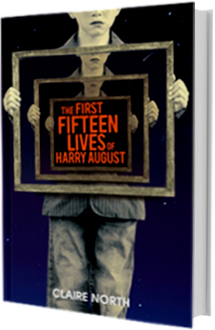
Harry August is on his deathbed. Again. No matter what he does or what decisions he makes, when death comes, Harry always returns to where he began, a child with all the knowledge of a life he has already lived nearly a dozen times before. Nothing ever changes. Until now. As Harry, at a ripe age of 78, nears the end of his eleventh life, a little, 7 year old girl appears at his bedside. 'I nearly missed you, Doctor August,' she says. 'I need to send a message back through time.'
The First Fifteen Lives of Harry August is an extraordinary journey of one unforgettable character - Harry August. It is also a story of friendship and betrayal, loyalty and redemption, love and loneliness and the brave, although ultimately hopeless, fight against the ruthless march of time.
The First Fifteen Lives of Harry August is a novel by a British author Catherine Webb, writing under a pseudonym Claire North. Catherine Webb has a long history as a pseudonymous author, writing 6 fantasy novels for adults under the name Kate Griffin. This is the first time when she has, as Claire North, ventured into science fiction genre and the result is rather satisfying.
The author says that having a History degree from London School of Economics helped her a lot when she was researching the history for this book - Harry August spends a lot of time dodging World War II for example, so getting the chronology of the major events leading to WW2 right, was very important in keeping the story believable. But while she admits that her generic knowledge of the big events in the history was very useful, she hastens to add that a great deal of the history of ordinary folk isn’t about the big events – it is zooming in on the little, rather ordinary, things ‘in the background’ that made the time of Harry August and his contemporaries come alive. For example, year 1936 would not be described by someone living in the era as 'a year when war became inevitable' since in 1936, war wasn't inevitable and no one without the burden of hindsight would think of it in terms of war, whatever history has to say on the subject now. Rather, for people living in those times, it would be a year of economic recovery, jazz and the rise of 'talkie' movies, and a year when premiered Charlie Chaplin’s last silent movie Modern Times.

But back to our hero. When, in his next incarnation, Harry duly delivers the message 'The world is ending' to the Cronus Club, whose members are people who live their lives over and over again as Harry does, he is told that there is no hope of effecting change. What follows is Harry's investigation into the inevitable apocalypse, and his troubled relationship with a 'fellow traveller' Vincent, intent on hastening the world's technological progress for his own ends. The novel is ultimately not only an examination of determinism and free will, but also a subtle study of the meaning of friendship, complexity of life and existence.